Shared Article
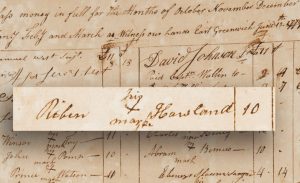
Local Enslaved Men Fought in Revolutionary War
In an era when cities and towns across the nation are reexamining the heritage of their black citizens, it is fitting for Jamestown to do the same.
In an era when cities and towns across the nation are reexamining the heritage of their black citizens, it is fitting for Jamestown to do the same.
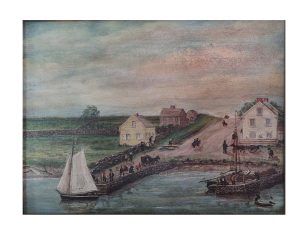
In the 19th century – before the invention of the movie, television, and computer – most people, especially in tiny towns like Jamestown, had to make their own entertainment. Fraternal organizations that provided social activities as well as mutual support and/or intellectual stimulation flourished. Among these organizations were debating societies.
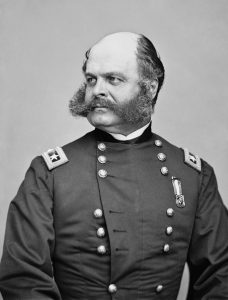
During World War II, Conanicut Island was home to three named forts, all of which are now parks – Fort Burnside at Beavertail, Fort Getty on the West Passage, and Fort Wetherill on the East Passage. Each of the forts was named for a U.S. Army officer who had seen active service in the second half of the 19th century.
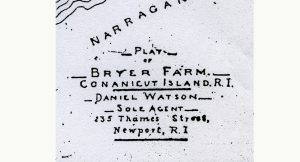
In the mid-19th century, the population of Jamestown was declining. The 1870 census counted only 378 people living here. Those remaining knew the town would die if nothing were done.
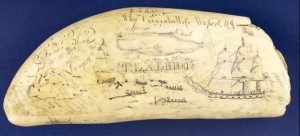
The African-American and Native American community in Jamestown burgeoned during slavery, but it declined precipitously after the Revolution. Nine tenths left in only 50 years.
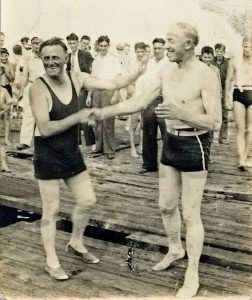
George Wallin Bowen and his brother James Howard were born on the Point in Newport in 1882 and 1884, respectively. In their 20s, the two brothers went their separate ways – George to Chicago; J. Howard, as he was known, to the U.S. Navy.
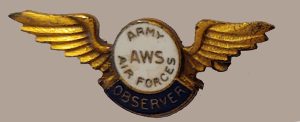
From 1938 through 1940, the United States watched with growing concern the war that was engulfing Europe. Air warfare directed against civilians, demonstrated in the Battle of Britain in the summer of 1940, led some – especially on the eastern seaboard – to fear for the vulnerability of our coastal communities.
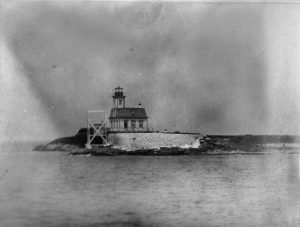
Gustavus Adolphus Clarke, known as G. Adolphus, was one of Jamestown’s many descendants of Joseph Clarke, one of the original purchasers of Conanicut Island. He was born in Jamestown in 1839, eighth of the nine children of David Wright and Sarah Chaffee Clarke. He was in his mid-teens when his father died and his mother moved with the younger children to Newport.
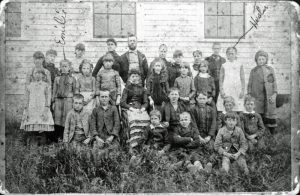
For the first 30 plus years of their lives the two Tennant sisters lived uneventful lives in their father’s home on Narragansett Avenue. Born in Jamestown in 1873 and 1874 respectively, Hester and Emilie went to Jamestown’s South School in the days of one-room schoolhouses when the ninth grade was the highest grade taught.
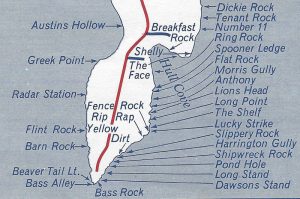
In early Jamestown through the first half of the 20th century, the area that is now Beavertail State Park was a popular fishing ground. As early as 1754, the Newport Colonial Lighthouse Committee had guaranteed a Right of Way to the water around the lighthouse.
